

The soul purpose of the Anacrusis art style is to accentuate good game play and core mechanics and best depict the core pillars of our IP while doing it within the constraints of a shoe string indie budget\resources.

Knowing the purpose and rules of the art style creates a framework for which you can begin to craft the universe. The style is purposeful and deliberate and tells a story, it is functional, yet elegant. The game is set in the future approximately 400 years from the present day. It is a mix of late 60’s Early 70’s scifi pre Star Wars and “rusty tech” greebles and post 50’s Ray Gun’s. It is a mix of 2001: A space Odyssey, Mod, Minimalism and retro tech. We reference Syd Mead, John Berkey, John Harris and Chris Foss.

In this world you can travel across galaxies, teleport and shoot laser guns however we still have large clunky analogue buttons that do simple things. My idea is to depict what the implied future would be through a 1970’s lens, sleek and analogue, not what the 70’s looked like in reality or nostalgia for the 1970’s but something new. I take the perspective that we use the design language of the era, however technology is sophisticated and materials are advanced. We do not take the present day perspective of the future like Alexa or “smart” technology, instead we take conventional objects and make them 70’s tech in space. They still have vacuums that clean the shag carpet, though they might be an automated droid with chrome lined with exotic ceramic walnut paneling. Humanity has traveled to the stars and succeeded to become at least a Type II Civilization on the Kardashev Scale. Humans have discovered worm hole technology and have begun to harness it. We have solved the struggles of our earthly problems such as hunger, poverty and war. The objects of this civilization reflect a higher level of elegance and sophistication as seen through a 1970’s eye. There is an appreciation for aesthetic detail and elegance with analogue functionality. The world should depict this. Objects have a richness and texture that is sleek and clean, this shows the futurist style but also creates a great contrast for the level of destruction the aliens have done.


Surfaces should be designed to show off the form of an object and richness of materials. This will help for the relatively clean materials to catch light and show off reflective properties. A key visual feature of the 2001: A Space Odyssey are the glints metal and plastic pick up on the curved surfaces. This helps to abstract shape yet show off physical properties of materials and is extremely easy to achieve in with PBR. This can also bee seen in the futurist gauche paintings as large graphic swaths of white known as “Bird Poop” to create highlights
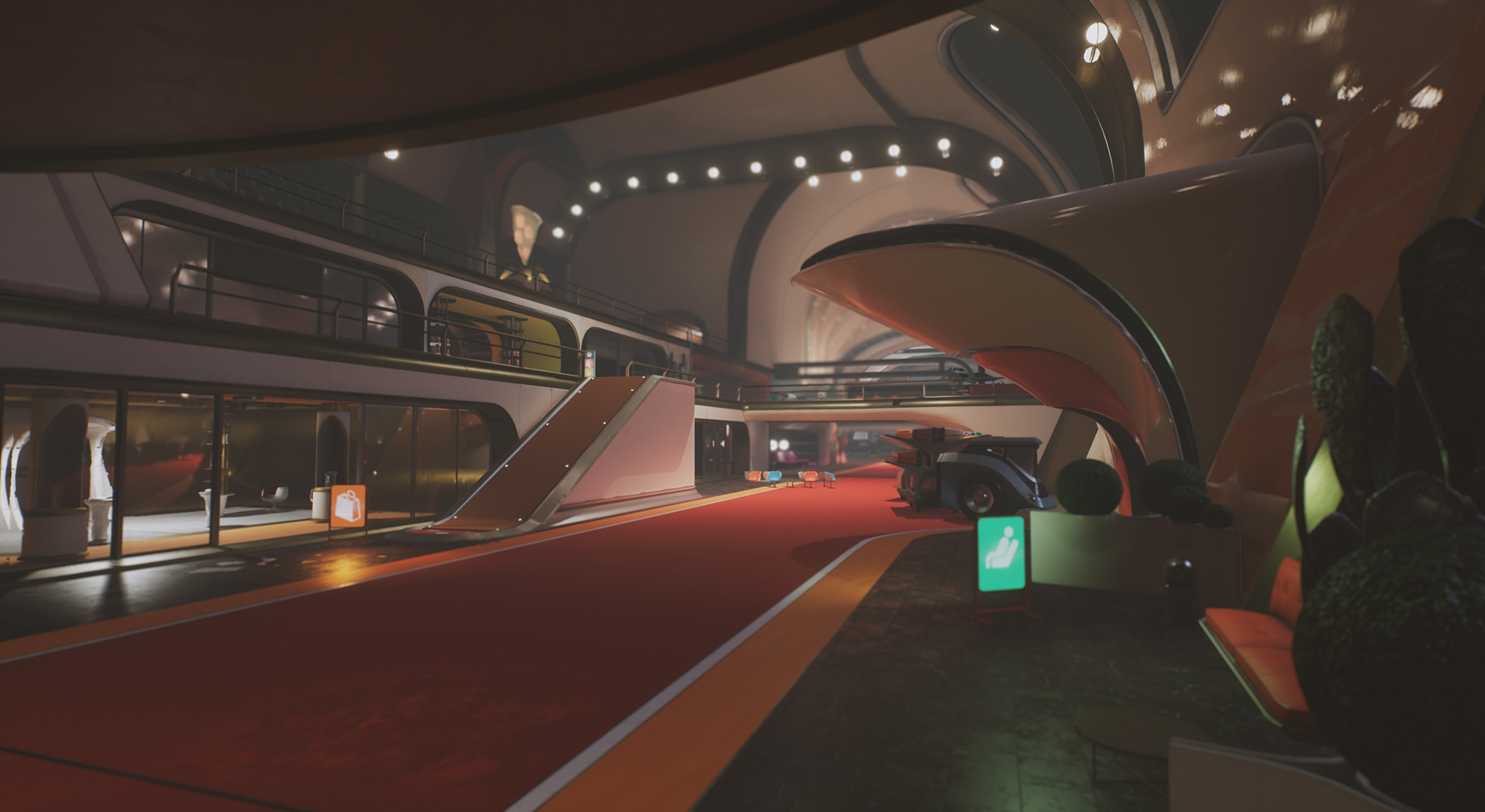
Coinciding with avoiding flat surfaces the structure and designs of most objects have elegant sweeping curves that echo the futurist and “Googie” designs of the 60’s & 70’s. We also want to reference modern day architect Zaha Hadid who uses many of the same forms updated and on a much grander scale

Materials for the most part are clean and have little wear unless the area is heavily damaged. They will depict day to day use however the wear appears in areas that helps tell a story like where people use handles on doors, carts scrapping against walls or heavy destruction caused by the aliens. There is not grunge and wear for the sake of detail. Contrast and affinity.

One of the key elements of our world are large areas of affinity or “Sameness”. These act as great areas to place punchy graphics that can help describe our world and add interest cheaply

There is no space magic! No design for the sake of design. There is a strong purpose for everything. The reason something is shaped or formed either describes it’s function or serves to evoke some sort of feeling for people in an area. Ambiguous 45* angled scifi design is non existent and you commit a cardinal sin when this is done


Initially I start with 2D thumbnails exploring composition and shape language. These are fast and loose and very freeing. The rougher the better, from these the style begins to emerge. From a game design perspective spaces that are "actual" and are designed for humans to traverse work well for AI. Real world spaces heavily influence or blockouts.


After this phase I explore more specific spaces, and begin to play with the style, shape and color. I have still not settled on an aesthetic but begin to iterate. When I find elements that resonate I narrow my focus. These are combinations of 3D and 2D elements. I begin to put the a stake in the ground on design elements that are working, shiny clean curved surfaces. Sleek designs and elegant forms emerge. I begin to think of the biggest space and the smallest space we might encounter and what the extremes of those might be. I flesh out 3D concepts.


With level design we begin to plot out the spaces. Quick loose sketches are done to flesh out the look and feel of a specific area. I "Story Board" out areas quickly in 2D. The visual target is then built upon these sketches. I am then able to define the aesthetics and fully realize the style of the game from the players perspective.


